
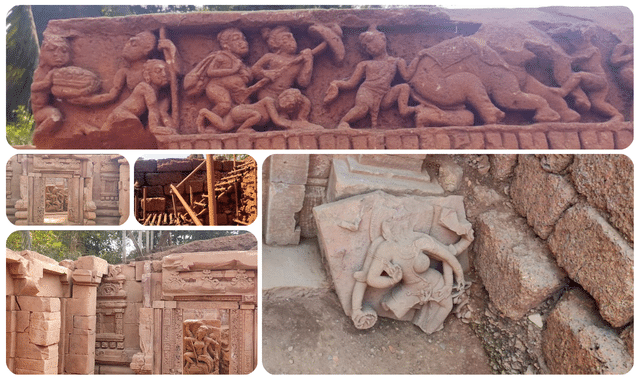
The ruins of a medieval Devi temple were discovered buried beneath the Sukasari temple, located on the left side of the iconic Lingaraj temple in Bhubaneswar, the city renowned for its temple heritage.
The Archaeological Survey of India (ASI) is currently conducting excavations at the site, revealing what is believed to be an ancient Durga temple in the rare Khakhara style, where the goddess is worshipped instead of Lord Shiva, diverging from the typical Shaivite dominance in the region.
The discovery came to light during the excavation of the Sukasari temple, which had been closed for over two and a half years. ASI officials estimate that this underlying Devi temple predates the Sukasari temple by 2-3 centuries, making it one of the oldest Khakhara-style temples in Odisha. Excavations, which resumed after initial work in October 2021, have unearthed significant artefacts, including an eight-armed statue of Goddess Durga, idols of Lord Vishnu, Gajalakshmi, and Narasimha, along with pottery, stone inscriptions, and other relics. Experts speculate that the temple dates back to the 7th or 8th century during the Bhaumakara dynasty, while the overlying Sukasari temple is attributed to the 13th century under the Ganga dynasty.
ASI Superintendent Nanda Kishore Swain emphasised the site’s cultural and historical significance, stating, “This medieval temple is a vital part of Ekamra Kshetra’s heritage. The unearthing of a Shakti Peeth in a predominantly Shaivite area is a rare occurrence.” The Khakhara style, characterised by its rectangular structure, unlike the more common square or circular Rekha and Pidha designs, is typically dedicated to goddesses. Similar examples in Odisha are scarce, with notable ones including the Durga temple at Baideswar in Banki, Gangeswari Temple at Bayalish Baati near Gop and Barahi temple at Chaurasi in Puri district
The excavation, involving around 30 workers and supervised by Bhubaneswar MP Aparajita Sarangi, MLA Babu Singh, and ASI officials, aims at both restoration and long-term preservation. The project, funded by the central government with a budget of Rs 3 crore, resumed after delays due to financial approvals. Work is progressing cautiously from 8 AM to 5 PM daily, with expectations that it could take one to two years to complete. Labour supervisor Natabar Bhoi noted, “We’re proceeding slowly due to the fragile ruins. Whatever emerges is carefully documented and preserved by archaeologists.”
The site was initially identified through advanced scanning techniques near the Lingaraj temple’s north gate and the sacred Bindusagar pond. ASI’s efforts revealed the buried Sukasari temple first, followed by the deeper Devi ruins. The state government has cleared unauthorised structures around the area and handed over the premises to ASI for seamless operations.
According to ASI data, the “City of Temples” once boasted over 1,000 shrines. Today, only 200 remain, with many lost to poor maintenance. Rare Khakhara temples like the unearthed Devi site are found in limited locations across Odisha. Of these, 23 are protected by ASI and 15 by the state archaeology department.
This discovery underscores the need for renewed focus on conserving Odisha’s ancient architectural marvels, particularly rare Peeths like this Devi temple, which features ancient stone inscriptions.
As excavations continue, historians anticipate more insights into the region’s layered religious history, blending Shaivite and Shakta traditions.