As communities worldwide observe World Rabies Day today, India stands at a critical crossroads in public health.
September 28 marks not only a global day of education and prevention but also the anniversary of the death of Louis Pasteur, the visionary French chemist and microbiologist who developed the first lifesaving rabies vaccine.
While vaccines remain our best tool against rabies, recent trends in India show that awareness and timely medical care are equally vital.
The Ground Reality: A Two-Year Retrospective in India
Data compiled through the National Rabies Control Program (NRCP) and local health surveillance over the past two years highlights a deeply concerning upward trajectory in animal interactions.
Government data reveals over 37 million dog bites and numerous rabies deaths, heavily straining healthcare infrastructure across India.
Regional reports from states like Maharashtra, Jharkhand, and parts of the National Capital Region reflect surging numbers at civil hospitals and municipal health centres. For instance, districts like Ranchi and Nashik have reported thousands of monthly animal bite incidents, putting immense pressure on local antirabies clinics.
Conversely, success stories like Goa—which maintains rigid cross-border surveillance, aggressive stray dog vaccination under “Mission Rabies,” and robust post-mortem tracking—prove that regional containment and zero-rabies targets are entirely achievable through disciplined execution.
Challenges: Supply Chains, Counterfeits, and Rural Gaps
Despite widely available vaccines, supply chain hurdles persist. Recent crackdowns on counterfeit anti-rabies batches in Delhi and Uttar Pradesh have exposed major vulnerabilities in medical distribution.
Authorities have had to scramble to seize fraudulent stocks, reminding regulatory bodies of the life-or-death necessity of stringent quality control.
Unlike urban residents who receive prompt post-exposure prophylaxis (PEP), rural victims often face dangerous delays and rely on traditional remedies or distant travel for care.
Bridging the Gap Through Awareness and “One Health”
Rabies is unique among infectious diseases: once clinical symptoms appear, the fatality rate is virtually 100%.
However, it is simultaneously 100% preventable through immediate wound washing, prompt administration of the vaccine, and pre-exposure prophylaxis for high-risk individuals like veterinarians and children.
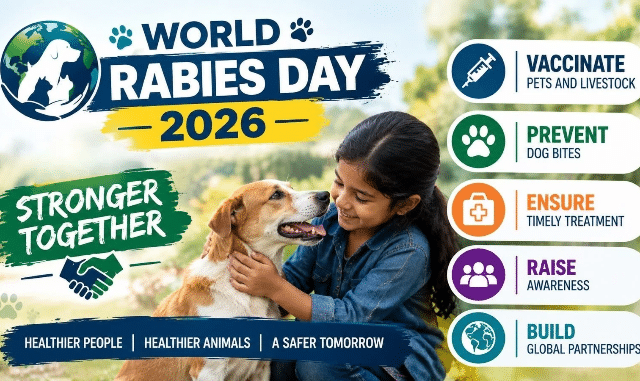
Aligning with this year’s global focus on the theme ‘Stronger Together’, Indian health authorities are doubling down on the “One Health” framework—integrating human medicine, veterinary care, and environmental management.
Central to this strategy are the Animal Birth Control (ABC) Rules, which mandate large-scale sterilisation and anti-rabies vaccination for stray populations, alongside mass public education campaigns.
As India marches toward its vision of a rabies-free nation by 2030, World Rabies Day serves as an urgent reminder: defeating this disease requires more than just medicine on a shelf.