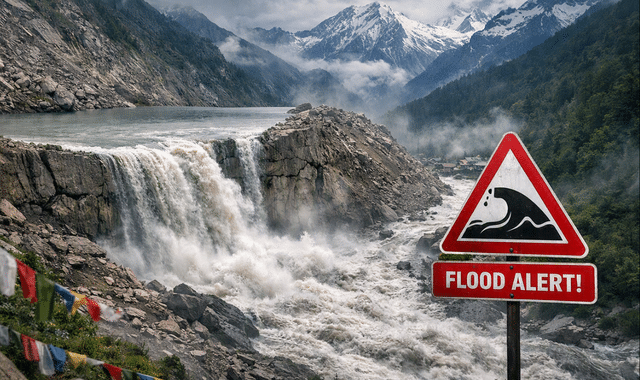
Authorities in Nepal are on high alert after China issued a warning that a newly formed barrier lake near the Nepal–Tibet border could overflow within three days, unleashing another destructive flood downstream.
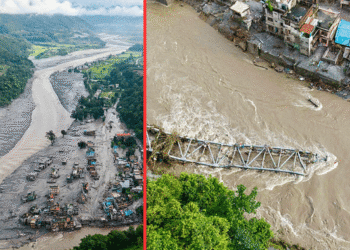
The alert comes just a day after massive glacier collapse triggered deadly flooding in the Bhotekoshi River, underscoring the growing vulnerability of Himalayan communities to climate‑driven disasters.
On August 26, satellite imagery captured a large section of the Langtang Lirung glacier breaking off at 5,200 metres. The ice mass crashed into the Lhende River, forming a temporary dam that burst and sent a surge of water roaring through Nepal’s valleys. The resulting flood wave peaked at Devghat in Chitwan, with discharge rates reaching nearly 5,850 cubic metres per second. In total, about 20 million cubic metres of water swept downstream, dwarfing the infamous 1985 Dig Tsho glacial flood.
China simultaneously faced its own crisis, as a mudslide buried parts of Gyirong Port in Tibet, leaving three dead and more than 550 missing. President Xi Jinping ordered an all‑out rescue operation, while engineers began monitoring the barrier lake formed at the confluence of the Chhochen Khola and Purepu Tsangpo rivers. The lake already holds 2 million cubic metres of water and is overflowing, with another 3 million cubic metres expected to accumulate in the coming days. Simulations suggest that a breach could send catastrophic floods into Nepal’s river systems.
Nepal’s Department of Hydrology and Meteorology has urged residents along the Bhotekoshi, Trishuli, and Narayani rivers to avoid riverbanks and remain vigilant. Emergency teams are preparing for possible evacuations, while cross‑border coordination with China continues.
Experts warn that the Himalayan region is experiencing an alarming rise in glacial lake formations, from 1,900 in 2005 to more than 2,600 today, driven by accelerating ice melt. This trend has made sudden floods more frequent and more devastating.
The latest disaster marks the second flood in just 14 months along the same stretch of river, highlighting the urgent need for regional cooperation and climate adaptation measures. Scientists emphasize that glacial hazards are no longer isolated events but recurring threats that demand long‑term planning, resilient infrastructure, and community awareness.
For Nepal, the warning is both a test of preparedness and a reminder of the fragile balance between human settlements and the volatile Himalayan environment.
As the barrier lake continues to swell, the coming days will determine whether preventive measures can avert another tragedy or whether the region will once again face the fury of nature unleashed.