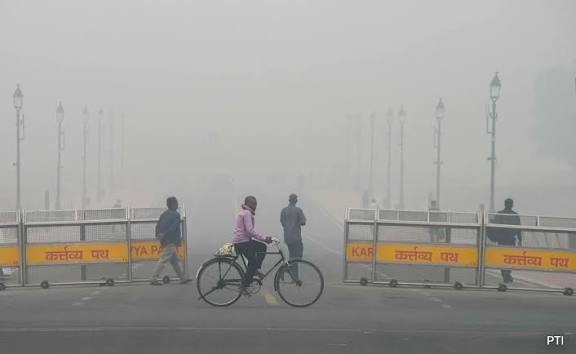
Delhi woke up to another day of severe air pollution on Sunday, as the Air Quality Index (AQI) crossed alarming levels, with some areas seeing values nearing 400.
According to the Air Quality Early Warning System, Delhi’s overall AQI stood at 392, placing it in the ‘very poor’ category. As the capital faces its worst air quality this season, efforts are underway to prevent the enforcement of Stage III of the Graded Response Action Plan (GRAP), which may bring more stringent measures.
Key Points on Delhi’s Air Quality Crisis:
-
Severe Pollution Across Multiple Areas
On Sunday morning, 21 of Delhi’s 39 monitoring stations recorded an AQI of 400 or above, marking the air as ‘severe’. Notable areas such as Alipur (415 AQI), ITO (420 AQI), Nehru Nagar (426 AQI), and Wazirpur (435 AQI) registered pollution levels far above the safe limits. In the broader NCR region, Noida (354 AQI), Greater Noida (336 AQI), and Ghaziabad (339 AQI) also reported severe air quality. -
Air Quality Improving Compared to Last Year
According to the Delhi Pollution Control Committee (DPCC), air quality in November 2025 is better than last year. Despite the high AQI on Sunday, the first week of November has shown improvements due to timely interventions by various government departments. However, DPCC Chairman Sandeep Kumar cautioned that the city is still not out of danger, as AQI levels remain high in many parts of the city. -
Efforts to Prevent GRAP-III Activation
Delhi’s officials are working hard to avoid reaching Stage III of the Graded Response Action Plan (GRAP), which would bring stricter pollution controls. GRAP-III was implemented in November 2024, but with efforts like mechanised road sweeping and water sprinkling in highly polluted zones, authorities are hopeful that stricter measures can be avoided this year. Sandeep Kumar emphasized that the support of residents and sustained government actions could help the city prevent a repeat of last year’s air quality crisis. -
Noida and Ghaziabad Struggle with Worst October Air in Five Years
Noida and Ghaziabad recorded their worst October air quality in five years, with Noida’s average AQI for October 2025 reaching 236, much higher than previous years. The early Diwali celebrations, marked by heavy traffic and fireworks, are partly to blame for the worsening air quality. Ritesh Tiwari, regional officer at UP Pollution Control Board (UPPCB) in Noida, noted that major traffic snarls contributed to the increase in vehicular pollution. -
PM2.5 and PM10 – The Main Culprits
PM2.5 and PM10, tiny airborne particles from vehicle emissions, industrial activity, and construction dust, remain the primary pollutants causing the hazardous air. These microscopic particles can penetrate deep into the lungs and bloodstream, posing significant health risks, especially for children, the elderly, and those with respiratory diseases. -
Concerns Over Data Accuracy
There have been concerns about the accuracy of AQI readings. Some online videos have shown water sprinkling near monitoring stations, raising questions about whether it could affect the data. However, DPCC officials have clarified that water sprinkling is a citywide practice and does not target specific stations. Furthermore, they maintained that 24 out of 39 monitoring stations have provided complete data on air quality.