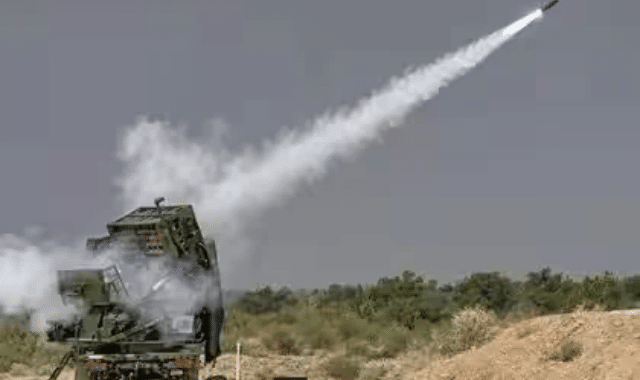
India has completed in-house development trials of Bhargavastra, the country’s first indigenously designed and developed two-layer, vehicle-mounted counter-swarm drone system, at the Pokaran field firing ranges in Rajasthan.
Conducted by Solar Defence and Aerospace Limited (SDAL) between November 20 and 24, the milestone significantly strengthens India’s air defence readiness against coordinated drone swarm attacks.
Built to neutralise hostile drones, weaponised UAVs, loitering munitions, and autonomous swarms, Bhargavastra employs a two-layer “hard-kill” mechanism combining indigenous unguided rockets and precision micro-missiles.
Unlike soft-kill jammers that only disrupt communication or navigation links, Bhargavastra physically destroys incoming targets—making it effective even against autonomous drones operating without active data links.
Mounted on mobile platforms, the system can be rapidly deployed across deserts, plains, and high-altitude border zones up to 5,000 metres above mean sea level. Its Command and Control Centre integrates data from surveillance radars capable of detecting drones up to 10 km away, alongside Electro-Optical/Infrared (EO/IR) sensors and passive radio frequency (RF) detectors.
Once threats are identified and classified in real time, the system assigns multiple targets to launchers simultaneously so swarm attacks do not overwhelm defences. Bhargavastra is also designed to integrate seamlessly with the Indian Armed Forces’ Command, Control, Communication and Intelligence (C4I) networks.