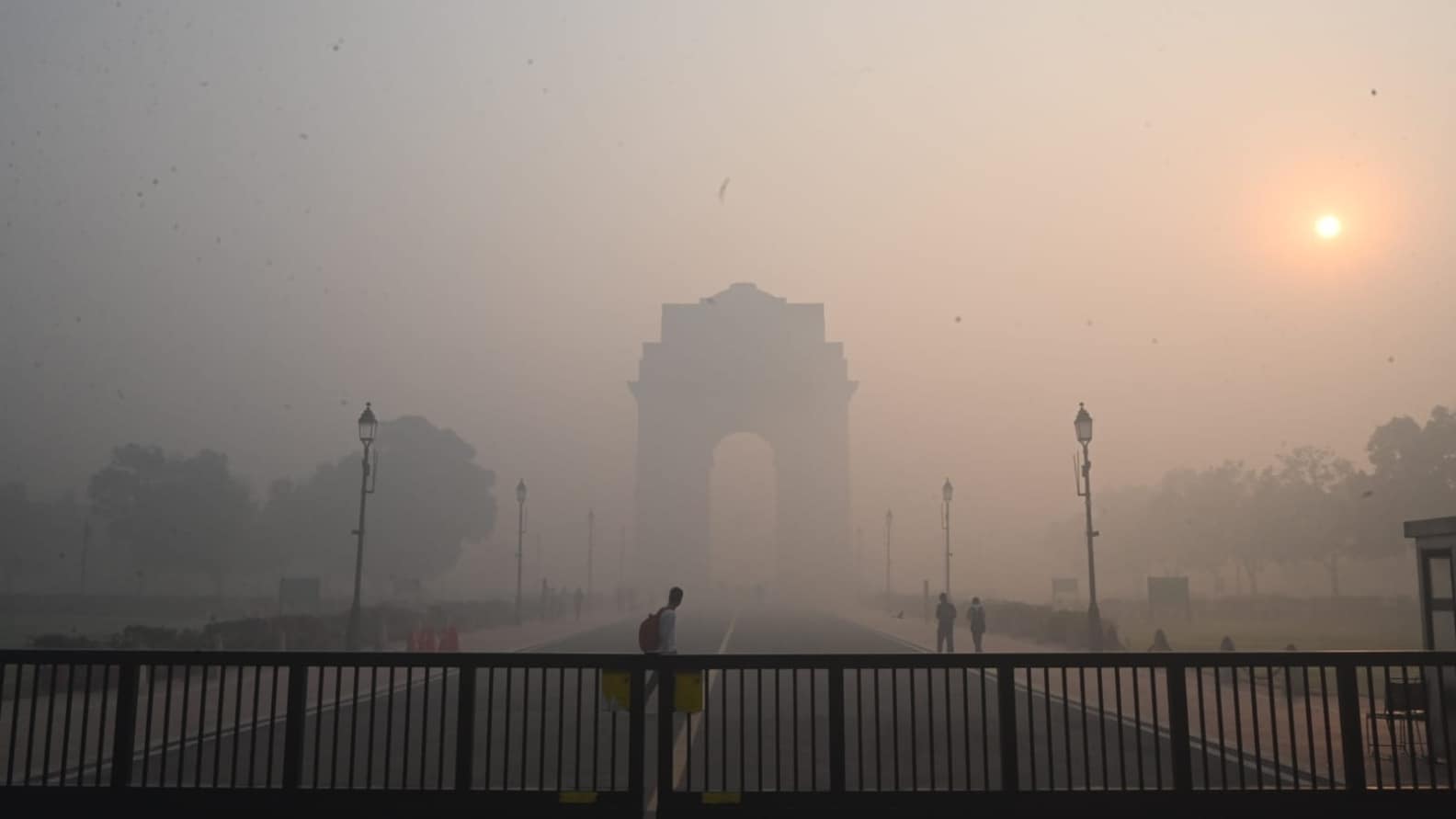
Delhi’s air quality remained firmly in the “very poor” category on Sunday morning, with the overall Air Quality Index (AQI) recorded at 351 at 8 am, according to Central Pollution Control Board (CPCB) data.
Although this reflects a 17-point improvement from Saturday’s morning reading and a notable decline from Friday’s “severe” average of 403, toxic smog continues to pose serious health risks—particularly for children, the elderly, and individuals with respiratory ailments.
Data from all 59 active monitoring stations identified PM2.5 as the primary pollutant across 51 locations. Despite the citywide dip, several neighbourhoods breached the “severe” threshold (above 400). IIT Delhi recorded an alarming AQI of 426, followed by NSUT Jaffarpur (407), Pusa (403), and North Campus (400), while Chandni Chowk registered 384.
Unfavourable meteorological conditions are hampering dispersion. Morning fog, 91 per cent humidity, a temperature of 21 degrees Celsius, and sluggish winds at 3.7 km/h have trapped fine particulate matter close to the surface.
While forecasted rainfall may bring brief relief, experts warn lasting improvement requires curbing vehicular, industrial, and stubble-burning emissions.
With GRAP Stage III restrictions—including construction and vehicular curbs—active across Delhi-NCR, authorities urge residents to limit outdoor exertion, use air purifiers, and report open burning via helpline 1800 202 5051.