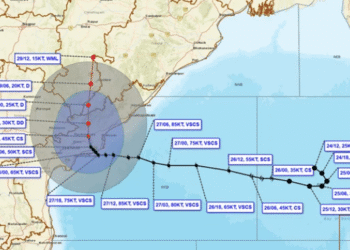
Even as Severe Cyclonic Storm Arnab completes its landfall process over the Andhra Pradesh and Yanam coasts and begins to weaken while moving inland, a fresh weather system has emerged far to the east.
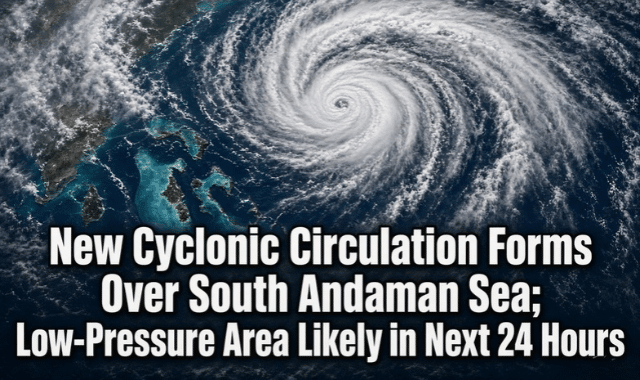
The India Meteorological Department (IMD) has confirmed the formation of a new upper-air cyclonic circulation over the South Andaman Sea and neighbourhood. Under its influence, a low-pressure area is likely to form over the same region during the next 24 hours.
IMD Director General Dr. Mrutyunjay Mahapatra stated that the circulation developed over the South Andaman Sea on Tuesday. Various weather models indicate that the system may gradually move in a north-northwestward direction and evolve into a low-pressure area over the east-central Bay of Bengal. Some models even suggest the possibility of further intensification into a depression or cyclonic storm, though the IMD has emphasised that no conclusive forecast on its track or intensity is available yet. Official updates on any potential direct impact over Odisha will be issued as the system develops.
According to the latest IMD observations, the upper-air cyclonic circulation over the South Andaman Sea extends up to 5.8 km above mean sea level and continues to persist. This development comes amid the ongoing influence of Cyclone Arnab, which crossed the Andhra Pradesh and Yanam coasts southwest of Yanam (near 16.45°N and 81.9°E, about 20 km east-northeast of Narsapur) between 2:00 am and 8:00 am IST on October 28 as a very severe cyclonic storm with maximum sustained winds of 125-135 kmph, gusting to 150 kmph. The landfall process has since completed, and the system has weakened while moving slowly north-northwestwards over coastal Andhra Pradesh and adjoining areas. It is expected to weaken further into a deep depression by midnight.
The northern spiral bands of Arnab have already affected coastal Andhra Pradesh and Yanam, with notable impacts also reported in southern Odisha districts, including heavy rainfall. IMD continues to monitor both systems closely and is issuing regular updates.
Meteorologists note that the formation of multiple low-pressure areas or cyclonic circulations in the Bay of Bengal during this period is not uncommon. Even after the influence of Arnab diminishes, the new system could contribute to increased rainfall and wind speeds along the coasts of Odisha and Andhra Pradesh.
In light of the developments, fishermen have been advised against venturing into the sea, while coastal residents are urged to follow official advisories and remain vigilant. The IMD has stressed that it is closely tracking the evolution of the Andaman Sea circulation and will provide timely updates on its movement and intensity.
Authorities in Odisha and Andhra Pradesh remain on alert as the region navigates the aftermath of Arnab while preparing for any additional weather activity from the fresh system.